Friday, November 25, 2022

Good Morning Venice!

The moment I'll remember most from my recent visit to Venice was when I emerged from a dark alley onto a wide sidewalk on the banks of a busy canal. It was very early and the canal was alive. Water taxis and vaporettos, delivery boats and cargo barges. The sounds of motors blaring from boats going to and fro, their captains calling out to each other. The hurried pace of locals and tourists, on my side of the canal and on the far bank, scurrying up the stairs to the Santa Lucia Train Station.

I hadn't expected this wondrous moment. 'Good morning, Venice!' I almost said aloud. I couldn't believe that I had arrived in this marvelous city, crisscrossed with canals instead of streets. The sun had yet to rise and here I was, witnessing the dawn while strolling along the Grand Canal.

We stayed three nights in the Albergo Marin, a small hotel just a short walk from the Piazzale Roma bus terminal. Albergo Marin advertises itself as a 'charming, sanitized one-star boutique hotel—it was a really pleasant place to stay. Except possibly for the very steep, narrow steps we needed to climb to our second-floor room.

We took a vaporetto to St. Mark's Square and made our way through the throngs of tourists, but didn't bother to stand in the long line leading into St Mark's Basilica. We took the elevator to the top of Campanile di San Marco, the bell tower with an observation platform offering a panoramic view over the Square, the city's orange rooftops, the canals, and the islands.

Some highlights of our Venetian stay:

Doges Palace (Palazzo Ducale) - the residence and the seat of Venetian government, symbol of Venice and a masterpiece of Gothic architecture, has incredible interiors including intricately gilded and painting-covered ceilings. We did something extra special when we visited. We took the Secret Itinerary tour, a small guided tour of palace rooms "where the delicate work of some of the most important bodies in the Venetian administration was carried out." Climbing up one steep darkened staircase after another, we saw the palace's jail cells, including the one where Casanova was held prisoner and from which he later escaped. We saw the complex's torture chamber and the Chamber of the Council of Ten, seat of the administrative body that worked with the Doge and his counselors to rule the Venetian state. By taking this tour, we also had the chance to walk inside the famous Bridge of Sighs!

Inside the Doges Palace

The view from inside the Bridge of Sighs

Burano – we rode the vaporetto past Murano, the island famous for Venetian glass production (much of which has shut down following the pandemic and the rise in natural gas prices) and arrived on the island of Burano. We strolled along its canals, fascinated by the colorful houses along their banks and amused by the island's leaning bell tower. We sat down for espresso and essi (Burano's traditional s-shaped biscuits) and admired the view. For lunch, we had pasta in a restaurant alongside a canal. Overall, a wonderful relaxful morning – highly recommended!


Vivaldi Concert - The Italian composer Vivaldi (1678 – 1741) was born in Venice and it is said that he composed many of his works in the Santa Maria della Visitazione church, also known as the Vivaldi Church. What an amazing place to hear a performance of Vivaldi's 'The Four Seasons' (composed around 1720, the modern church was built three decades later)! The performance was by a string ensemble conducted by master violinist Alberto Martini. With the church's excellent acoustics, this was a concert to remember!

What else will I remember from our short stay in Venice? Eating bite-size Venetian cicchetti while drinking Campari; wandering through the streets and over canal bridges without getting lost (thanks to Google Maps, although I was disappointed by the lack of fog); the good food; our visit to colorful Burano; and the grandeur of the Doges Palace. But more than anything else, I will always cherish my memory of seeing the early morning hubbub of Venice's busy canals for the first time.


Tuesday, November 15, 2022

"How Sweet It Is…" to See "Sweet Baby James"

When I told my colleagues that I had traveled to Florence, Italy, to see a concert of James Taylor, they asked, "Who is James Taylor?"

I could respond by simply telling them that James Taylor is an American singer-songwriter and guitarist, but for my wife and me, he is something much more than that. We grew up listening to, and singing along with Taylor's songs, as well as to the other pop and folk music performers of our generation. We never imagined that one day we would attend one of his performances.

When dates were announced for Taylor's 2022 international tour, we hurried to purchase tickets for his concert in Florence. We were very optimistic, with hopes that COVID-19 travel restrictions would no longer be in place, and planned our Italian vacation around the concert.

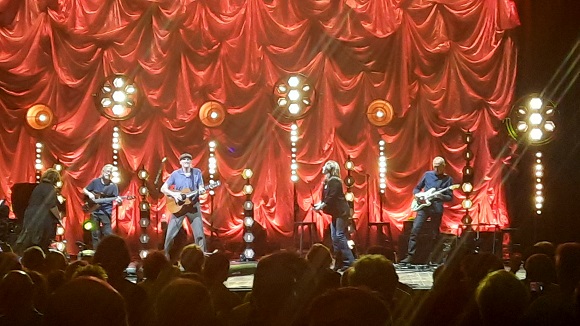
The concert was held in Teatro Verdi, a theater located in the very heart of historic Florence, and we booked a hotel within walking distance. We were impressed by the grandeur of the theater, which was built in 1854 and seats 806, especially by the six tiers of theater boxes that seemingly reached up to the ceiling.

James Taylor and his All-Star Band took the stage and opened with "Something in the Way She Moves" and "Country Road". We were immediately enraptured by the songs we know so well. At the age of 74, Taylor is still an excellent singer, although his voice has mellowed over the years. We especially enjoyed the fact that he spoke to the audience between songs, speaking of their origins and occasionally sharing jokes, some of which the mostly Italian-speaking audience didn't fully understand.

We sang along, snapping photos that couldn't do justice to the heartwarming concert. Taylor's renditions of favorites "Sweet Baby James", "Fire and Rain" and "You've Got a Friend" and all the other songs stayed true to the studio-versions that have played background to our lives for decades. We rose to our feet and joined the audience singing "How Sweet It Is (To Be Loved by You)", saddened with the realization that the concert was nearing its end.

A wonderful experience that will remain in our memories for years to come!

The full playlist of the Florence concert:

  • Something in the Way She Moves
  • Country Road
  • That's Why I'm Here
  • Walking Man
  • Never Die Young
  • (I've Got to) Stop Thinkin' 'Bout That
  • Sweet Baby James
  • Steamroller
  • Copperline
  • Long Ago and Far Away
  • Up on the Roof  
  • Teach Me Tonight  
  • The Frozen Man
  • Bittersweet  
  • Don't Let Me Be Lonely Tonight
  • Fire and Rain
  • Carolina in My Mind
  • Shower the People
  • Your Smiling Face
  • You've Got a Friend  
  • How Sweet It Is (To Be Loved by You)  
  • You Can Close Your Eyes 

Postscript: A few days after the Florence concert, several members of the All-Star Band tested positive for COVID-19 and shows in Zurich and Frankfurt were postponed or canceled. And then, Taylor himself began suffering from symptoms of COVID-19 as well (although the latest social media posts report that he is on his way to a full recovery).

We are so very lucky to have attended the concert, especially having bought our tickets a year in advance. We will always cherish our memories of seeing James Taylor perform live in Florence.

Tuesday, November 8, 2022

"A Stand-Up Comedian Walks Into a Bar" - short story


"Tough crowd tonight."

"You can't win them all," Mac said, slumping into a chair at the side of the club.


"Some of your jokes are quite funny."


"Nah, no one's laughing."


Mac picked up a bottle of water and guzzled half of it before coming up for air. Upon hearing the roar of laughter greeting the next comedian performing on Open Mic night, he rubbed his eyes. "I need new material." When he realized that he was talking to himself, he brushed off his clothes and left.


Mac had dreamed of becoming a stand-up comedian his entire life. He could make a career of it, he imagined, but his wife was not supportive of the idea. "Stand-up doesn't pay the bills," she complained. He would moonlight as a comedian, he vowed, until he achieved the recognition he felt he deserved.


Read the rest of the story on Esoterica Magazine.

Saturday, November 5, 2022

"Running in Time" - short story

“Are you going running tomorrow?”

“Tomorrow? Maybe.”

I didn’t run every day, but there were days when I needed to. It wasn’t only about getting back in shape; it was also about getting back in time.

As my wife turned off the bedroom light and kissed me goodnight, I closed my eyes and smiled to myself, remembering how wonderful a day it had been.

I had gone on my morning run—3 miles in the park, which was pretty good for a 60-year-old man, especially after what had happened—and came back to find breakfast laid out on the table for me. I hopped into the shower and then joined her at the table, a cup of steaming hot coffee already placed at the side of my plate.


Read the rest of the story at On the RunPhoto by Nourdine Diouane on Unsplash

Wednesday, October 26, 2022

Taxi Politics - short story


Israel held elections in April 2019; September 2019; March 2020; and March 2021. The 5th elections in our political drama will be held on November 1, 2022. The short story "Taxi Politics" is as relevant today as it was when it was first written in January 2020.

“So, what do you say about our country? Staging elections for the third time this year! Where else in the world do you have a country like this? And we call ourselves a democracy! Is it a democracy when we can’t elect a stable government? What do you say about that?”

The man in the backseat looked up from his phone, surprised that the driver had spoken to him.

“What?”

“Elections! They’re coming around the corner again and I wondered what is your opinion?”

“My opinion?”

“Yes, your opinion. Every citizen is entitled to have an opinion. I meet many people every day and let me tell you. Everyone has an opinion. What’s yours?”

Friday, October 14, 2022

And Then My Sukkah Collapsed


I was full of enthusiasm and good intentions as I unpacked the pieces of the pre-fab sukkah I had purchased especially for the holiday. It should be a simple matter of fitting together the metallic poles and the do-it-yourself sukkah would be standing.

A sukkah is a temporary dwelling in which Jews "dwell" - or at least eat their meals - during the week-long festival of Sukkot. The temporary status is reminiscent of the years of wandering that the Children of Israel endured on their way to the Promised Land.

Two hours after beginning to build our sukkah, the sukkah collapsed. Poles, and connecting pieces, plastic and metal, all lying on my patio at my feet.

That was on the eve of the holiday of Sukkot, twenty years ago. What I wrote at the time makes me laugh today but back then, I nearly cried with frustration. Here is what I wrote in 1999, many holidays ago.

Not prepared for the holiday rush

I saw an advertisement for pre-fab sukkot at a reasonable price. The company had a Jerusalem location, so I went there one morning before the holiday. It appeared that many others had the same sukkah-buying plans and I had to park a distance from the shop.

The company was not prepared for the holiday rush. There were more customers than salesmen, and the employed workers were quite inexperienced. Chalk it up to the fact that sukkot are only sold once a year, in the period before the holiday. Even so, the staff should have been trained for their job.

When I finally cornered a young salesman, I told him that I was looking for a 2-meter by 3-meter sukkah. My main concern, I said, was to make sure the 3-meter poles would fit in my car. "No problem," the salesman assured me. But he gave no clues how I would transport the poles.

I asked if the company made deliveries. "We'll come Saturday night, but very late," I was told What time was late? I asked. "We'll call you after midnight and let you know what time." I preferred to skip the all-night vigil and decided to try my luck elsewhere.


Anyone can do it

I saw an advertisement, for a competitor in the pre-fab sukkah business. This company claimed that its sukkah poles were no longer than 1 meter in length and were conveniently packed in carrying cases.

I approached a sales agent who turned out to be someone who ran an auto supply shop. He had never previously dealt with pre-fab sukkot. Even so, he assured me that the sukkah's construction was very simple and anyone could do it. The poles were attractively packaged in heavy-duty carry bags, which would have done a golf caddy proud. I paid for the sukkah. It easily fit it into the trunk of my car.

At home, connecting the black plastic pieces was not as easy as it sounded. There were four bags of different-shaped plastic, pieces quite similar to Lego. I looked for instructions, but there were none. Then I remembered the salesman's words. "It is very simple. Anyone can do it."

Logic dictated that a sukkah should be built from its corners. I took my hammer and began forcing the poles into connecting, angular pieces. Amazingly, the poles fit into place. The construction began to take shape, one frame of plastic after another. I enlisted my family to help, holding up one side as I worked on the other. This should do it, I thought, but the end results appeared lopsided and illogical. I told everyone to let go, and that is when the flimsy construction collapsed.


I want my money back!

"Didn't you follow the instructions?" the auto supply salesman asked me the next day. "What instructions?" I shouted. “I demand a refund!” There was only one problem. My sukkah had been taken out of its packaging and there was no money back guarantee.

The salesman gave me two pages of instructions. ‘Put pole A into black piece B’. If I couldn’t do it myself, the salesman promised me that he would personally come to my house and build the sukkah.

I decided to give the construction one more chance. This time I had instructions. I dutifully followed them, step by step. Within a short time, and without the help of my family, I had a formidable construction standing, one that would surely withstand the week-long holiday without collapsing on the dwellers within.

Of course, a sukkah is more than just the poles which form its sides. There are the sheets which serve as the walls and the schach which makes up the sukkah's roof. These are minor matters, compared to the struggles of getting the sukkah to stand in the first place.

Sukkot is a joyous holiday, one when families get together for festive meals in the luxury of flimsy constructions that stand for a week on patios, balconies and in backyards. After the frustrations and sweat that went into the building of my family's sukkah, I anxiously looked forward to sitting back and enjoying the fruits of my labor.


Originally published September 26, 1999 on About.com

Related article:

I Built My Sukkah Upside Down!


Sunday, October 9, 2022

I Built My Sukkah Upside Down!

When you purchase a sukkah in Israel it's supposed to be a lifetime investment. The so-called sukkah l'netzach is easily constructed and then stored away after the holiday for future use. How is it, then, that I've gone through four or five of the contraptions over the years?

The first "ever-lasting" sukkah I bought was nothing more than a set of irrigation pipes. The end of each pipe had to be screwed onto the next pipe's connecting threads with the help of a monkey wrench. This sukkah swayed dangerously in the slightest breeze. After one or two holidays, the end of the pipes broke off, effectively shortening its shelf life.

The second sukkah I purchased, also designed for eternal use, was a marketer's mad concept of an Erector Set. It constituted two golf bags filled with a multitude of bars, angles, connecting joints and support pieces. There were diagrams included but construction was worse than finishing a 2,000-piece jigsaw puzzle. The sukkah stood in place at last, and then it collapsed.

Of course, sukkot are more than just the corner poles and support beams. If you do manage to get the skeleton structure upright and standing, there is also the matter of the walls. Tradition calls for the use of shipment container wood, the real reason anyone makes aliyah or sends a lift of goods to Israel. This usage traces back to the containers carried on the backs of the Israelites' camels during their exodus from Egypt. Lacking this wood, sheets can be tied to the poles and then reused as bedding covers after the holiday.

It is important to remember that a sukkah is a temporary hut or booth only for use during the holiday itself. Therefore, pouring a concrete roof is unsuitable. Instead, software developers invented schach l'netzach, the beach thatch that is imported specially from the bungalows of Sinai. Over the years, the schach tears in enough places to allow for ample starlight to filter through to the guests inside the sukkah as they merrily shake palm fronds left and right.

With the sukkah fully assembled and the schach amply sheltering everyone from the seasonal rains that fall every year during the holiday, it's time to decorate. In the United States this is a simple task. There you just stock up on Christmas decorations in December and use them in your sukkah the following autumn. Luckily in Israel there is no shortage of frilly, metallic-colored streamers and crepe paper pomegranates available and people flock to the Sukkot fairs to purchase them along with the funny-shaped etrog that also plays a part in holiday traditions.

Back to me. This year's construction of our latest sukkah l'netzach took the usual amount of blood, sweat and frustration. Soon our sukkah was standing proudly on our back patio, covered with a new carpet of bamboo schach. It's time to decorate. But wait! Going into the house I feel that something is inherently wrong with my booth.

The sukkah is upside down! No, I don't mean that the schach is actually at my feet with the sky totally exposed. I have mistakenly placed our sukkah poles upside down. As a result, there is a ledge of two inches that one must step over to come inside. How could this have happened? Admittedly, there was no diagram or construction manual for this most recently acquired sukkah model but I assumed it could be assembled by instinct alone.

Okay, we'll watch where we walk when we enter our sukkah for tonight's festive meal. Upside down or not, we're ready to celebrate.

Originally published on The Times of Israel in September 2012.

Sunday, September 25, 2022

Return to Lifta

A hike through the abandoned Palestinian village showed me not much has changed since I graduated from high school there nearly 50 years ago.

The Jerusalem Experimental HighSchool had its first permanent facility in a renovated abandoned house in Lifta on the outskirts of Jerusalem and I studied there for two years in the 1970s. The school later relocated to the center of Jerusalem, but my memories of walking along a scenic path through Lifta on my way to classes are still crystal clear.

My high school was in this building
Just last month, the Jerusalem Municipality and the Israel Lands Authority agreed to shelve and “rethink”plans to turn Lifta into a boutique neighborhood for the rich, complete with luxury housing, a hotel, and an upscale commercial and business center. Recently, however, the Lifta Boutique Hotel opened its doors with 6 luxuriously furnished suites, an infinity pool, jacuzzi, and sauna, overlooking the valley.

According to media reports, Jerusalem Mayor Moshe Lion wants to preserve the village and turn it into a World Heritage Site. It is not clear to me, what that would mean.


Driving into Jerusalem, the abandoned buildings of Lifta are quite an eyesore. They stand in sharp contrast to the recently constructed railway bridge that towers over the valley. The houses are a remnant of a vibrant Palestinian Arab community that was forcibly evacuated in 1948, before the establishment of the State of Israel.

A misleading statement issued by the Jerusalem Municipality states that the "village dates back to the days of the Second Temple and continued to exist in various ways until the War of Independence."

Following the war, Israel settled hundreds of immigrants from Yemen and Kurdistan in Lifta, but because of the poor conditions, including lack of electricity and other infrastructure, they were asked to leave and compensated, and holes were drilled in the roofs of their homes to discourage squatters.

One of the buildings was used in 1984 as the base of the so-called "Lifta Gang", a Jewish terrorist group that plotted to blow up the mosques on the Temple Mount. Gang members were stopped at the last minute with 250 pounds of explosives, hand grenades, and other weapons.

The school where I studied became a drug abuse rehabilitation center for adolescents, but this shut down in 2014.

Inside one of the abandoned buildings in Lifta

Today, the village is part of the Mei Neftoach nature reserve, and efforts are being made to improve access to the spring at its center. The village attracts ultra-Orthodox youths from the nearby Romema neighborhood, wayward youths seeking solitude, and Jerusalem's Arab residents looking for ways to reconnect with their national heritage.

Mei Neftoach spring
What should be done in Lifta? Should it serve as a neighborhood for the rich? Should the former Palestinian owners be compensated, or allowed to return? Should the abandoned buildings be left as is, for future generations to decide their fate?

In the meantime, Lifta is a unique and colorful hiking destination in Jerusalem. Walking along its pathways and peering into its collapsed homes is a step into the past, an exploration that raises questions about the village's future.