Thursday, January 27, 2022

Please rescue ‘The Girl from Oslo’!

 
Two young Israelis and their Norwegian friend are on their way home from a holiday on the beaches of Sinai when they are kidnapped by Daesh terrorists. Held captive in mountain caves and Bedouin encampments, they are threatened with death unless 12 Islamic State members are released from prison, including a terrorist leader being held in Norway.

This is the beginning of the Netflix series ‘The Girl from Oslo’ (2021), created by Kyrre Holm Johannessen and Ronit Weiss-Berkowitz. Presented as the next big Israeli dramatic thriller to hit the streaming screens, the series is as much of a need of a rescue as the captives held in Sinai.

The ominous score; the panoramic scenes of Jerusalem from above; and a multitude of scowls, secrets, and scandals give the series the air of a soap opera. Ten episodes are a bit much. The terrorists should have been killed and the prisoners released much sooner.

The series stars Andrea Berntzen as the kidnapped red-cheeked Norwegian girl, Pia; Anneke von der Lippe as the mother who would do anything, even reveal her innermost secrets, to get her daughter’s release; and Amos Tamam as the hapless Israeli Minister of Intelligence, who seemingly can’t do anything right.

Outstanding performances are delivered by Raida Adon, as the mother’s Palestinian friend; and Rotem Abuhab, as the minister’s wife. Jameel Khoury is impressive as a wheelchair-bound Hamas commander, but ‘Fauda’ costar Shadi Mar'i is completely wasted in his role as a terrorist-in-training.

Many things are hard to believe in the series. All that the best Israeli intelligence officers can do on the captives’ behalf is stand motionless as their drones follow them from above. The Minister of Intelligence seems to be the only government official concerned with the incident. There is no explanation for relentless, seemingly unprovoked Israeli bombing of Gaza. And, the Egyptians don’t seem to be involved in what is happening in their territory.

Still, there is one reason to watch ‘The Girl from Oslo’, and that is the stunning desert landscapes where much of the action takes place. Although portrayed as Sinai, the series was actually filmed in the Negev and the Arava, and in Timna in particular. Israel’s southern regions have never before been shown so beautifully on the screen.

Netflix spends billions of dollars on content. One can only hope that the next Israeli thriller to stream on the service will be a bit more believable than ‘The Girl from Oslo’.


Originally posted on The Times of Israel.

Friday, January 21, 2022

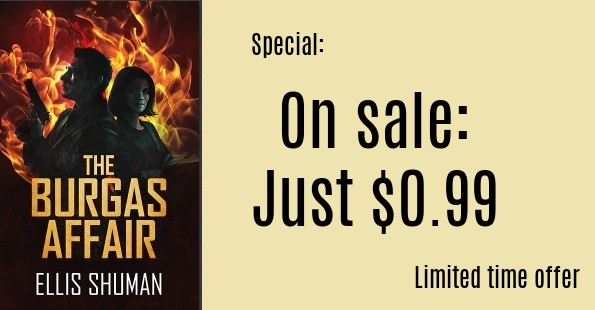
My Books On Sale!

For a limited time only, you can purchase all three of my books for just $0.99 (
£0.99 in the UK).

This is your chance to read The Virtual Kibbutz, Valley of Thracians, and The Burgas Affair at a discounted price!


Purchase The Virtual Kibbutz here.

Purchase Valley of Thracians here.

Purchase The Burgas Affair here.

Enjoy!

Friday, January 7, 2022

"The Tiger" - short story

“There’s a tiger in the playground!”

“That’s nice, Shmuel.”

“No really, Imma. It was coming toward me, but I didn’t run. I wasn’t scared at all!”

“That sounds very exciting! You’re so brave! Now, go wash up and call your brothers. It’s almost time for Havdalah.”

The tiger was like an enormous cat wearing a mask. A colorful Purim mask. Amber eyes stared at him as the large animal swayed back and forth with feline grace, its tail whisking in its wake. Its ears stood at attention; its paws were huge. Shmuel couldn’t see, but he could imagine, the beast’s razor-sharp teeth, and the thin white whiskers under its triangular pink nose. Such a pretty face!

Read the rest of the story on JewTh!nk

Photo by A G on Unsplash

Saturday, January 1, 2022

2021 - My Writing Year in Review

2021, for me, was a year of short stories. Writing them and submitting them. The seven stories that were published online in 2021 are listed below. Twelve of my stories are included in Rakiya, my collection of short stories set in Bulgaria. That manuscript is now on submission with literary agents and independent publishers.

My main success of 2021 was having Rakiya selected as a finalist in the Eyelands Book Awards 2021 - an international contest for published/unpublished books based in Greece. While the collection did not win the contest, it is an honor that it made the shortlist.

I continued my habit of sitting in the Aroma coffee shop in the early morning, writing on my laptop before starting my work day. Due to the ongoing COVID-19 pandemic, I work most of the week remotely from home, so the number of times I came to Tel Aviv to sit in Aroma was limited. A good portion of my writing time was spent researching online literary journals and publishers suitable for my submissions.

Some writers keep track of statistics – how many stories they submitted and how many were accepted for publication. So, here are mine. In 2021, I made 122 short story submissions (many of them simultaneous submissions of the same story). 20 stories were withdrawn (having been accepted elsewhere); 78 story submissions were rejected; and 6 stories were accepted for publication.

As 2022 begins, a number of my short stories are ‘on submission’ and I am hopeful that one day soon they will be published. Hopefully there will be positive responses to my submission of Rakiya as well.

Thank you for taking the time to read my stories and share my writing career!


The Muse - CommuterLit.com 

Lockdown - Literary Yard           

Sozopol - The Write Launch

Three Women in Sofia - Literary Yard

Applesauce - Bright Flash Literary Review

Nocturnal Visitors - Across the Margin

The Magician - Mad Swirl

Photo by Markus Winkler on Unsplash

Tuesday, December 14, 2021

"The Magician" - short story

For years he sought to perform the ultimate illusion. An astounding feat that would captivate audiences. A magic trick like no other which would make them truly appreciate him and win their long overdue praise. The recognition he deserved. Just one fantastic stunt was all he needed. It had eluded him so far, but eventually it would come to him. Of this, he was certain.

He had been called to the world of magic as a young boy after seeing a television variety show. Glued to the screen, he was held spellbound. He recorded every movement in his mind so he could later recreate the tricks.

He started with “Abracadabra” performances for his family. He staged hocus pocus skits for classmates and performed at talent shows as Kid Magician—a stage name he would retain throughout his career. His first tricks were simple ones. Endless strings of colorful handkerchiefs, ropes with mysteriously disappearing knots. Taps of a magical wand and classic card tricks.

“There’s nothing up my sleeve,” he declared, his black cape swirling around him. But his classmates didn’t believe him.

Read the rest of the story on Mad Swirl.

Photo "Magic in the Air" by Tyler Malone

Thursday, December 9, 2021

Review of ‘More Than I Love My Life’ by David Grossman

Israeli author David Grossman’s new novel More Than I Love My Life, translated by Jessica Cohen (Knopf, August 2021), has been praised by critics as "captivating" and "powerful", a "delicately crafted novel" that is a "remarkable achievement to [his] long list". Yet despite all the praise, I can’t help but say that it left me a bit disappointed.

Goli Otok is a barren, uninhabited island off the coast of Croatia. In the early 1950s, it was home to a notorious political prison. The novel flashbacks to when the fictional ninety-year-old Vera was held on Goli Otok for refusing to denounce her husband as an enemy of Josip Broz Tito's communist state. These flashbacks are indeed powerful, but the novel is much more than a historical account of those tragic events.

Instead, it focuses on the intergenerational relations between Vera; her daughter, Nina; and her granddaughter, Gili. Along with her father, Gili sets out to make a documentary of Vera’s return to the island. Their unlikely journey reveals intertwined layers of familial love and betrayal that transcend the travel tale, emphasizing the novel’s emphasis on the ability of family members to remember, forgive, and to regain love across the generations.

The second half of the book, depicting the visit to the island and containing the most traumatic flashbacks, is definitely better than the first half, which makes one wonder why the story couldn’t have started with the family’s arrival in Croatia.

Much of the narrative is told as the four characters travel through rural Croatia. Anyone who has driven in Croatia knows that the roads are often not in the best condition. They wind through the countryside and there are speed traps in the picturesque villages. How could the characters navigate those unfamiliar roads at night, in the rain, for hours, while Gili films her documentary, turned around to face Vera and Nina in the backseat? That would be uncomfortable and reckless, to say the least.

While Vera and Gili, and even Raphael, Gili’s father, are believable characters, getting a grasp on Nina’s complex personality is difficult. She is unevenly portrayed—sometimes coming close to the others, sometimes hiding for years and years, sometimes being loving, sometimes running off by herself—making it hard to relate to her.

The family members keep secrets from each other, leading to feelings of betrayal, yet can one really say, at novel’s end, why those secrets were kept or what they are?

Readers will find it implausible that elderly Vera, in her nineties, is capable of climbing a steep mountain trail in the dark of night. That would be a challenging task in the daylight for anyone.

And finally, although Grossman is known for his creative and expressive literary style, and the translation of this novel is impeccable and faithful, one questions his use of archaic phrases like:

“From both those breasts I suckled.”

Trivial things, it’s true, but I couldn’t dismiss them from my mind as I read the book.

More Than I Love My Life was inspired by the true story of one of the author’s longtime confidantes who was imprisoned and tortured on the island. The novel, recognized in The Financial Times as one of the ‘Best books of 2021: Fiction in translation’, is bound to win other awards as well, but it failed to live up to my expectations. Having been disappointed with this book, as well as with his previous A Horse Walks into a Bar, I will be less likely to read the next David Grossman novel.

David Grossman is an acclaimed Israeli author of fiction, nonfiction, and children's literature. His works have been translated into more than forty languages. He is the recipient of many prizes including Israel’s Sapir Prize, the French Chevalier de l'Ordre des Arts et des Lettres, the Buxtehuder Bulle in Germany, and Rome's Premio per la Pace e l'Azione Umanitaria. In October 2021, Grossman was the first Berman Literature Prize in Sweden for his novel When Nina Knew/Life Plays With Me.

Jessica Cohen translates contemporary Israeli prose, poetry, and other creative work. She shared the 2017 Man Booker International Prize with David Grossman, for her translation of A Horse Walks into a Bar, and has translated works by major Israeli writers, including Amos Oz, Etgar Keret, Ronit Matalon and Nir Baram.

Originally published on The Times of Israel.

Tuesday, November 23, 2021

"Rakiya" Shortlisted for International Book Award

I am excited to share: Rakiya, my as-yet unpublished short story collection, has been listed as a finalist in the Eyelands Book Awards 2021 - an international contest for published/unpublished books based in Greece.

Rakiya is one of 4 finalists in the unpublished short story collection category. Winners will be announced on December 30th.

Full details of the awards and the finalists: https://eyelandsawards.com/

Thursday, November 18, 2021

Are These Writers Nuts? - #NaNoWriMo (from the archive)


Here’s the challenge: write a 50,000 word novel during November. That’s 1,667 words a day, every day, for thirty days. Don’t bother to edit now, just write. Who would take on this wild challenge? I have an excuse (I am currently in the advanced editing stages of an already written novel)*, but some 250,000 writers from all over the world are hitting their keyboards furiously every day this month. Some of them are published authors. Are they crazy?

Welcome to November, designated as the National Novel Writing Month. That’s NaNoWriMo for short, NaNo for even shorter…


According to the NaNo website, hundreds of thousands of writers around the world are expected to pledge to write 50,000 words during the month of November. “There are no judges, no prizes, and entries are deleted from the server before anyone reads them.” So, what’s the point?

“The 50,000 word challenge has a wonderful way of opening up your imagination and unleashing creativity,” says NaNoWriMo founder Chris Baty. “When you write for quantity, instead of quality, you end up getting both. Also, it’s a great excuse for not doing any dishes for a month.”

According to the site, more than 90 novels begun during the annual November promotion have since been published, including Water for Elephants by Sara Gruen, a New York Times #1 best seller.

This year, some of the writers started their NaNo project precisely at the stroke of midnight, November 1. Others hope for a fortuitous start if they begin writing at exactly 11:11 on November 11th. But by then, some of their fellow writers will have already written more than 16,000 words.

Maggie from "Maggie Madly Writing" says that she plans to “write precisely 1,667 words a day – sometimes a little more. On days when I know I’m not going to be around the computer, I’ll write two days’ worth of words in one day.”

Kim Wright, author of Love in Mid Air, which I previously reviewed, says that this is her first year for NaNo. “As a longtime writer, I’ve been vaguely familiar with the concept for years but I have the sense that it’s growing as a movement, building towards some sort of critical mass.”

Jeff, the self-described Doubting Writer, says he must be “nuts” to join the NaNo craze. “Whether I produce anything of value is an entirely different question.”

If you’re an aspiring writer, should you attempt NaNo this year? Here are 5 reasons to do it. As for advice how to get through the month, check out these NaNo Rules that Lead to Progress.

Good luck to all you NaNo writers! As I edit my previously written manuscript I'll be thinking of you. Let me know how you did when December comes around.

* This article was originally posted in November 2011. Ten years later, authors are still attempting to pen their novels during the month of November. Write on!

Photo by Thom Milkovic on Unsplash