Jewish singles around the world are quite familiar with JDate, the website where they anxiously post their profiles in hopes of meeting their beshert (Yiddish for ‘predetermined soul mate’). When Rhoda Ginsburg, a 41-year-old overweight Jewish divorcee signs up at the site, she never expects that her shidduch (Yiddush for ‘match’) will be with a Jewish rabbi who has been dead for hundreds of years.
“I would like to tell the story of my life,” says Rhoda’s date when they meet up at a bar. “What’s so special about your story?” Rhoda asks, unwilling to make their meeting a professional gig for her writing career. “I’m a vampire,” her date replies matter-of-factly.
A Jewish vampire? Oy, vey izt mir! (‘Oh, woe is me!’).
Monday, May 21, 2012
Saturday, May 12, 2012
Breakfast in Ein Kerem
The sun is shining brightly on the golden onion domes of the Russian Orthodox church on the hills overlooking the picturesque village of Ein Kerem. Down in the valley, tourists from all over the world flock behind their guides to Mary’s Spring or up the hill to the traditional birthplace of John the Baptist. While walking through the colorful and serene alleyways one can easily forget that the village is actually a neighborhood of the city of Jerusalem.
It’s Friday morning, and Jodie and I have a coupon for a free breakfast for two. Our chosen destination is Karma, a restaurant located in the very center of the village. Parking is a challenge, though, as the two levels of free underground parking lot across from the restaurant are completely full, a fact that is unknown to the guard who keeps signaling visitors to drive right in. Above the lot, tour buses are circling around and discharging their visitors. We’re lucky to find a tight spot under a tree not far away.
Monday, May 7, 2012
Did Anyone Ask for Elections?
Only a week or so ago, nobody was talking about having elections this year in Israel. The government led by Benjamin Netanyahu, whether we supported it or not, was firmly entrenched until sometime in distant 2013. And then, as if we almost missed their initial inception, early elections are all that we can talk about and will take place on September 4th. The only thing we’re lacking is an answer to the question - why?
Let’s not get our hopes up. If anyone expects Israel’s post-election government to be more stable, more capable of achieving social justice and/or restarting the peace process, he is probably unfamiliar with the fractious state of Israeli politics.
Monday, April 30, 2012
Yemen, So Close Yet a World Away
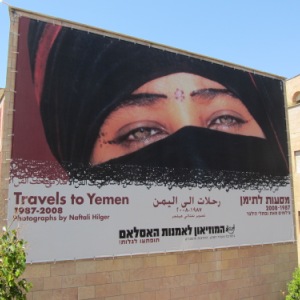
If you could get in a boat in Eilat and sail south on the Red Sea to the tip of the Arabian Peninsula, you would arrive in the Republic of Yemen, a nation rich with oil reserves but with a population that is one of the poorest on earth. Yemen, a colorful land that played an important home to Jews throughout the ages, has recently been in the headlines due to its role in the Arab Spring protests.
The L.A. Mayer Museum for Islamic Art in Jerusalem is hosting a stunning photographic exhibition entitled “Travels to Yemen 1987 - 2008”. The lens of renowned Israeli photographer Naftali Hilger’s camera offers a rare glimpse into a society caught far behind the rest of the world.
Monday, April 23, 2012
Google Takes to the Streets of Jerusalem
“To help you explore Israel’s history and present, we’ve launched imagery of Jerusalem, Tel Aviv-Jaffa and Haifa on Street View,” Google announced on its official blog yesterday. “You can explore the narrow streets of Jerusalem’s Old City and each of its four quarters, walk along the Via Dolorosa and see the Church of the Holy Sepulchre, visit the Western Wall and the Mount of Olives,” Google said.
In the coming months, Google will add imagery of the Dead Sea, Nazareth, Eilat and other Israeli towns. In the meantime, virtual visitors can already take 360 degree tours of some of Israel’s most popular attractions.
While not providing specifics, Google officials said at the official launch yesterday that they had met with security officials and had worked to ensure that Google Street View doesn’t constitute a security threat to Israel.
In the coming months, Google will add imagery of the Dead Sea, Nazareth, Eilat and other Israeli towns. In the meantime, virtual visitors can already take 360 degree tours of some of Israel’s most popular attractions.
While not providing specifics, Google officials said at the official launch yesterday that they had met with security officials and had worked to ensure that Google Street View doesn’t constitute a security threat to Israel.
Monday, April 16, 2012
Hiking Upstream of the Damaged Yitla Gorge
Last week Haaretz reported on the damage caused to the Yitla Gorge in the Judean Hills by the construction of a railway bridge, as part of the high speed line to Jerusalem scheduled to be completed by 2017. “The gorge we knew no longer exists,” said Avraham Shaked, a nature preservation coordinator with the Society for the Protection of Nature in Israel.
The mini-canyon of Nahal Yitla, a valley located to the northwest of my home in Moshav Neve Ilan, was considered as one of the “deepest and most impressive in the Jerusalem Hills.” The “Yitla Stream is situated in the heart of one of the best preserved Mediterranean grove areas in the Hills,” said Ze'ev Hacohen, a ranger from the Nature and Parks Authority. It “functions as a habitat for a variety of cliffs plant species and as a nesting site for predators species like falcons, buteos and eagle owls," he said. Yitla is not actually a stream, as there is no water in the valley.
Despite the ominous reports of environmental damage, on a hike upstream from the site of the controversial railway bridge I discovered beautiful, pristine green scenery in totally serene surroundings.
The mini-canyon of Nahal Yitla, a valley located to the northwest of my home in Moshav Neve Ilan, was considered as one of the “deepest and most impressive in the Jerusalem Hills.” The “Yitla Stream is situated in the heart of one of the best preserved Mediterranean grove areas in the Hills,” said Ze'ev Hacohen, a ranger from the Nature and Parks Authority. It “functions as a habitat for a variety of cliffs plant species and as a nesting site for predators species like falcons, buteos and eagle owls," he said. Yitla is not actually a stream, as there is no water in the valley.
Despite the ominous reports of environmental damage, on a hike upstream from the site of the controversial railway bridge I discovered beautiful, pristine green scenery in totally serene surroundings.
Monday, April 9, 2012
Author Interview with Kim Wright
Last year I read and reviewed a debut novel, Love in Mid Air - a story of American housewives that can best be classified as “chick lit”. I began corresponding with author Kim Wright because her follow-up book had nothing to do with that genre, but rather with the path authors must take in order to get their books published. As an aspiring novelist I have been following Kim’s advice for some time, and I’ve watched as her writing has gone off in new directions. I interviewed Kim to learn about her books and her plans for the future.
Monday, April 2, 2012
What Can Israel Do About the Suffering in Syria?
A total of 21 people were killed in Syria on Saturday despite President Bashar Assad's acceptance of a six-point plan that calls for an immediate cease-fire with rebels and an eventual democratic transition. According to officials at the United Nations, which is pushing the cease-fire plan, the estimated number of Syrians killed in the 13-month conflict is more than 9,000.
Israel and Syria are still technically at war, with much more than a disputed border separating the two nations. Yet Israelis cannot help but empathize with Syrian civilians bravely fighting the oppressive rule of Assad’s government. Unlike NATO’s intervention in Libya, it doesn’t seem as if the West desires to get involved in Syria’s internal strife. Is there anything that Israel can do to alleviate the suffering in Syria?
Subscribe to:
Posts (Atom)